JEE Main 2025 Physics question — Conservation of angular momentum
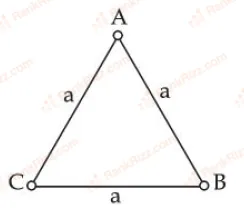
Three equal masses m are kept at vertices (A, B, C) of an equilateral triangle of side a in free space. At t=0, they are given an initial velocity , and . Here , and are unit vectors along the edges of the triangle. If the three masses interact gravitationally, then the magnitude of the net angular momentum of the system at the point of collision is :
SOLUTION
Since the masses interact only via internal gravitational forces, there is no external torque, and the total angular momentum () remains constant from until the point of collision.
By symmetry, the three masses will move in identical spiral paths and collide at the centroid () of the equilateral triangle. It is most convenient to calculate the angular momentum about this point.
For an equilateral triangle of side , the distance from any vertex to the centroid () is
The velocity vector is directed along the side . The angle between the position vector (from to ) and the side is . Therefore, the angle between the position vector and the velocity vector is
Tagged Conservation of angular momentum. Machine-assigned, so read it as a strong shortlist rather than a verdict.