JEE Main 2022 Physics question — Moment of inertia of standard bodies and composite systems
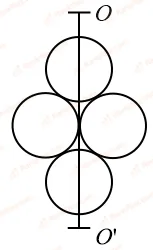
Four identical discs each of mass 'M' and diameter 'a' are arranged in a small plane as shown in figure. If the moment of inertia of the system about OO' is . Then, the value of will be _____.
SOLUTION
Solution & Explanation
Let each identical disc have a mass and a diameter . The radius () of each disc is given by:
The axis lies in the plane of the discs. It passes vertically straight through the centers of the top and bottom discs, and acts as a tangent line to the left and right discs.
Let us find the individual contributions of each disc to the total moment of inertia about :
- For the top and bottom discs (2 discs): The axis passes directly through their diameters. The moment of inertia of a uniform disc about its diameter is:
Combined contribution for both discs:
- For the left and right discs (2 discs): The axis is tangent to these discs in their plane. According to the Parallel Axis Theorem (), where the distance to the axis is :
Combined contribution for both discs:
Summing up the contributions of all four discs gives the total moment of inertia () of the system:
Comparing our result to the given expression template from the problem statement, :
Correct Answer Value: 3
Tagged Moment of inertia of standard bodies and composite systems. Machine-assigned, so read it as a strong shortlist rather than a verdict.