JEE Main 2021 Physics question — Moment of inertia of standard bodies and composite systems
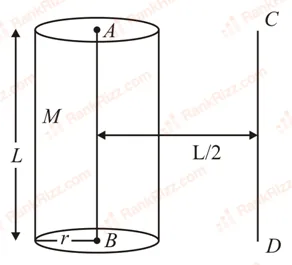
The solid cylinder of length 80 cm and mass has a radius of 20 cm. Calculate the density of the material used if the moment of inertia of the cylinder about an axis parallel to as shown in figure is 2.7 kg m.
SOLUTION
We need to calculate the density of the material used in a solid cylinder given its length, radius, and the moment of inertia about a parallel axis .
1. Extract and Convert Given Values to SI Units
- Length of the cylinder ():
- Radius of the cylinder ():
- Moment of inertia about axis CD ():
- Distance between axis AB and axis CD (): From the figure,
2. Understand the Moment of Inertia Formulas
The axis is the central longitudinal axis of the solid cylinder. The moment of inertia of a uniform solid cylinder of mass and radius about its own longitudinal axis is:
According to the Parallel Axis Theorem, the moment of inertia about an axis parallel to at a distance is given by:
Substituting the expression for and the value of :
3. Calculate the Mass () of the Cylinder
Substitute the numerical values of , , and into the equation to find :
4. Calculate the Density () of the Material
The volume () of a solid cylinder is calculated using the geometry formula:
Now, density () is defined as mass per unit volume:
Expressing the result in standard scientific notation matches the required formatting:
Final Answer: Option A ()
Tagged Moment of inertia of standard bodies and composite systems. Machine-assigned, so read it as a strong shortlist rather than a verdict.