RankRizz
JEE MAIN 2010TRANSCRIBED

JEE Main 2010 Physics question — Angular momentum of particles and rigid bodies

A small particle of mass mm is projected at an angle θ\theta with the x-axis with an initial velocity v0v_0 in the x−yx-y plane as shown in the figure. At a time t<v0sin⁡θgt < \frac{v_0 \sin\theta}{g}, the angular momentum of the particle is where i^,j^\hat{i}, \hat{j} and k^\hat{k} are unit vectors along x, y and z-axis respectively.
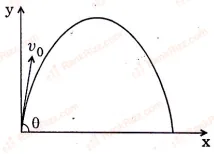
Figure for JEE Main 2010 Physics question on Angular momentum of particles and rigid bodies

SOLUTION

Key idea: Angular momentum about the origin is L⃗=r⃗×mv⃗\vec L = \vec r \times m\vec v. Motion in the xx-yy plane gives only a zz-component: Lz=m(xvy−yvx)L_z = m(xv_y - yv_x).

  1. Position: x=v0cos⁡θ tx = v_0\cos\theta\, t and y=v0sin⁡θ t−12gt2y = v_0\sin\theta\, t - \tfrac12 g t^2.
  2. Velocity: vx=v0cos⁡θv_x = v_0\cos\theta and vy=v0sin⁡θ−gtv_y = v_0\sin\theta - gt.
  3. Substitute: Lz=m[v0cos⁡θ t (v0sin⁡θ−gt)−(v0sin⁡θ t−12gt2)v0cos⁡θ]L_z = m\left[v_0\cos\theta\,t\,(v_0\sin\theta - gt) - \left(v_0\sin\theta\,t - \tfrac12 gt^2\right)v_0\cos\theta\right] =mv0cos⁡θ[−gt2+12gt2]=−12mgv0t2cos⁡θ= m v_0\cos\theta\left[-gt^2 + \tfrac12 gt^2\right] = -\tfrac12 m g v_0 t^2\cos\theta
  4. So L⃗=−12mgv0t2cos⁡θ k^\vec L = -\tfrac12 mgv_0t^2\cos\theta\,\hat k, pointing into the page. This matches the clockwise torque of gravity about the origin.

Answer: (C)

Tagged Angular momentum of particles and rigid bodies. Machine-assigned, so read it as a strong shortlist rather than a verdict.

SubjectPhysics
TopicAngular momentum of particles and rigid bodies
TypeMultiple choice