JEE MAIN 2007TRANSCRIBED
JEE Main 2007 Physics question — Parallel and perpendicular axis theorems
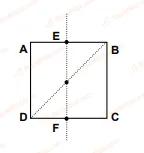
For the given uniform square lamina ABCD, whose centre is O,
SOLUTION
Key idea: Use the perpendicular axis theorem. For a square lamina, every in-plane axis through the centre has the same moment of inertia.
- Let the side be and the mass . About the axis through O perpendicular to the plane: .
- By the perpendicular axis theorem with any two perpendicular in-plane axes through O: .
- Both pairs (EF with the line parallel to AD) and (AC with BD) are symmetric pairs, so each axis has
- So .
- Check (B): about an edge , not .
Answer: (C)
Tagged Parallel and perpendicular axis theorems. Machine-assigned, so read it as a strong shortlist rather than a verdict.