JEE MAIN 2020 · 02 SEP S1+4 / −1MEDIUMTRANSCRIBED
JEE Main 2020 Physics question — Torque and the rotational form of Newton's second law
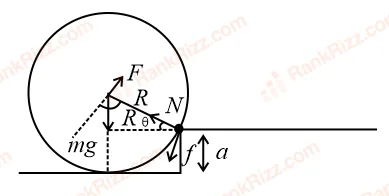
A uniform cylinder of mass M and radius R is to be pulled over a step of height a (a < R) by applying a force F at its centre 'O' perpendicular to the plane through the axes of the cylinder on the edge of the step (see figure). The minimum value of F required is:
SOLUTION
Torque equilibrium about the step corner:
Perpendicular distance for :
Perpendicular distance for :
Equating torques:
Tagged Torque and the rotational form of Newton's second law. Machine-assigned, so read it as a strong shortlist rather than a verdict.