JEE Main 2021 Physics question — Angular momentum of particles and rigid bodies
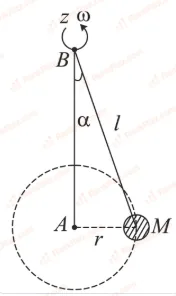
A mass hangs on a massless rod of length which rotates at a constant angular frequency. The mass moves with steady speed in a circular path of constant radius. Assume that the system is in steady circular motion with constant angular velocity . The angular momentum of about point is which lies in the positive direction and the angular momentum of about is . The correct statement for this system is:
SOLUTION
We need to analyze the characteristics of the angular momentum of a mass about two different reference points, and , during steady conical pendulum-like circular motion.
1. Analyze Angular Momentum about Point A ()
Point lies at the center of the circular path of the mass along the vertical axis of rotation (-axis).
- The position vector of the mass relative to point lies entirely within the horizontal plane of rotation.
- The linear velocity vector is tangential to the circle at every point.
- By definition, the angular momentum vector is:
- Using the right-hand rule, the direction of points straight up along the positive -axis at all times. Since the speed and radius are constant, its magnitude () and its direction remain completely fixed throughout the motion.
2. Analyze Angular Momentum about Point B ()
Point is located on the vertical rotation axis but at a height above the plane of the circle (the suspension point of the rod).
- The position vector points from down to the mass , tracing out the surface of a cone during motion.
- The angular momentum about is:
- Since and are always perpendicular, the magnitude of is constant ().
- However, by the right-hand rule, the vector is always perpendicular to the rod. As the mass rotates, the vector sweeps out a cone around the vertical -axis. Because its orientation is continuously changing in space, is not constant in direction.
Conclusion
Therefore, remains constant both in magnitude and direction, while changes its direction continuously. This corresponds to the correct choice on the page:
is constant, both in magnitude and direction (Option D).
Tagged Angular momentum of particles and rigid bodies. Machine-assigned, so read it as a strong shortlist rather than a verdict.