JEE Main 2021 Physics question — Torque and the rotational form of Newton's second law
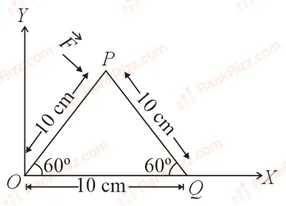
A triangular plate is shown. A force F=4i^−3j^ is applied at point P. The torque at point P with respect to point O and Q are:
SOLUTION
We need to determine the torque acting at point P with respect to point O and point Q on an equilateral triangular plate.
1. Identify the Geometry and Vector Positions
From the diagram on the, the plate forms an equilateral triangle with side lengths of 10 cm=0.1 m and interior angles of 60∘. Let's establish the coordinate positions by placing the origin at point O(0,0):
Point O:(0,0)
Point Q:(10,0) cm=(0.1,0) m
Point P: Located using trigonometric components along the side OP:
xP=10cos60∘=5 cm=0.05 m
yP=10sin60∘=53 cm=0.053 m
Therefore, the position vector of P relative to O is: rP/O=0.05i^+0.053j^
The applied force vector given in the problem is:
F=4i^−3j^
2. Calculate Torque with respect to Point O (τO)
Torque is defined by the cross product τ=r×F:
τO=rP/O×F=deti^0.054j^0.053−3k^00
τO=[0.05×(−3)−0.053×4]k^
τO=(−0.15−0.203)k^ N⋅m
Converting the units into N⋅cm to match the option formats (by multiplying the values by 100):
τO=−15−203
3. Calculate Torque with respect to Point Q (τQ)
First, find the position vector of P relative to Q: