RankRizz
JEE MAIN 2021 · 16 MAR S1+4 / −1MEDIUMTRANSCRIBED

JEE Main 2021 Physics question — Moment of inertia of standard bodies and composite systems

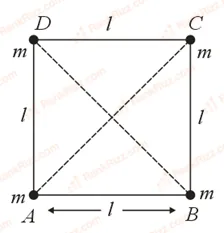
Four equal masses, mm each are placed at the corners of a square of length ll as shown in the figure. The moment of inertia of the system about an axis passing through AA and parallel to DBDB would be:

Figure for JEE Main 2021 Physics question on Moment of inertia of standard bodies and composite systems
SOLUTION

Let us place the square with vertices AA, BB, CC, DD at coordinates A=(0,0)A = (0, 0), B=(l,0)B = (l, 0), C=(l,l)C = (l, l), and D=(0,l)D = (0, l). The diagonal DBDB goes from (0,l)(0, l) to (l,0)(l, 0), so its direction vector is (1,−1)(1, -1) (or unit vector 12(1,−1)\frac{1}{\sqrt{2}}(1, -1)).

The axis passes through A=(0,0)A = (0, 0) and is parallel to DBDB. The line through the origin with direction (1,−1)(1, -1) has equation x+y=0x + y = 0, so the perpendicular distance of a point (x,y)(x, y) from this axis is d=∣x+y∣2d = \frac{|x + y|}{\sqrt{2}}.

For mass at A=(0,0)A = (0,0): dA=0d_A = 0, so dA2=0d_A^2 = 0.

For mass at B=(l,0)B = (l, 0): dB=l2d_B = \frac{l}{\sqrt{2}}, so dB2=l22d_B^2 = \frac{l^2}{2}.

For mass at C=(l,l)C = (l, l): dC=2l2=l2d_C = \frac{2l}{\sqrt{2}} = l\sqrt{2}, so dC2=2l2d_C^2 = 2l^2.

For mass at D=(0,l)D = (0, l): dD=l2d_D = \frac{l}{\sqrt{2}}, so dD2=l22d_D^2 = \frac{l^2}{2}.

The total moment of inertia is I=m(dA2+dB2+dC2+dD2)=m(0+l22+2l2+l22)=m×3l2=3ml2I = m(d_A^2 + d_B^2 + d_C^2 + d_D^2) = m\left(0 + \frac{l^2}{2} + 2l^2 + \frac{l^2}{2}\right) = m \times 3l^2 = 3ml^2.

Tagged Moment of inertia of standard bodies and composite systems. Machine-assigned, so read it as a strong shortlist rather than a verdict.

SubjectPhysics
TopicMoment of inertia of standard bodies and composite systems
TypeMultiple choice