JEE Main 2018 Physics question — Angular momentum of particles and rigid bodies
A thin uniform bar of length L and mass 8 m lies on a smooth horizontal table. Two point masses m and 2 m moving in the same horizontal plane from opposite sides of the bar with speeds 2v and v respectively. The masses stick to the bar after collision at a distance and respectively from the centre of the bar. If the bar starts rotating about its center of mass as a result of collision, the angular speed of the bar will be:
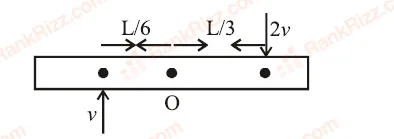
SOLUTION
Solution & Explanation
1. Find the Center of Mass of the Combined System After Collision
Let the thin uniform bar have a total length and mass . Its initial center of mass sits at the geometric center (origin ).
Two point masses ( and ) collide and stick to the bar at specific positions measured from the center:
- Mass lands at with a velocity vector pointing in the negative direction ().
- Mass lands at with a velocity vector pointing in the positive direction ().
We calculate the new position of the center of mass () for the fully joined system:
Because the net mass moments cancel out perfectly, the center of mass of the final combined system remains exactly at the original geometric center () of the bar.
2. Calculate the Total Initial Angular Momentum ()
We calculate the initial angular momentum about the system's stationary center of mass () right before impact using (taking the counter-clockwise rotation direction as positive):
- For mass : Moving with speed from the opposite side, it hits at a position vector of and tends to rotate the system counter-clockwise.
- For mass : Moving with speed from the bottom side, it hits at a position vector of and also tends to rotate the system counter-clockwise.
Summing them together gives the total initial angular momentum:
3. Calculate the Total Moment of Inertia () After Collision
After the completely inelastic collision, the total moment of inertia about the center point consists of the uniform rod plus both embedded point masses:
- Moment of Inertia of the bar:
- Moment of Inertia of mass :
- Moment of Inertia of mass :
Combine all terms by finding a common denominator (18):
4. Apply Conservation of Angular Momentum to Find
Since no external torques act on the system during the horizontal plane collision, angular momentum is conserved ():
Isolating the final angular speed ():
Correct Option Key: Option B ()
Tagged Angular momentum of particles and rigid bodies. Machine-assigned, so read it as a strong shortlist rather than a verdict.