JEE MAIN 2018 · 15 APR S1+4 / −1EASYTRANSCRIBED
JEE Main 2018 Physics question — Torque and the rotational form of Newton's second law
A force of 40 N acts on a point B at the end of an L-shaped object, as shown in the figure. The angle that will produce maximum moment of the force about point A is given by: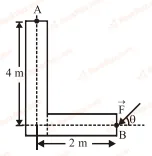
SOLUTION
Key idea: The moment is maximum when is perpendicular to .
- Take A as the origin. From the figure, B is 2 m to the right and 4 m below A, so .
- The force makes angle with the horizontal: .
- Moment:
- This is maximum when , which gives Check: this direction, , is indeed perpendicular to .
Answer: (C)
Tagged Torque and the rotational form of Newton's second law. Machine-assigned, so read it as a strong shortlist rather than a verdict.