JEE MAIN 2019 · 12 JAN S2+4 / −1MEDIUMTRANSCRIBED
JEE Main 2019 Physics question — Angular momentum of particles and rigid bodies
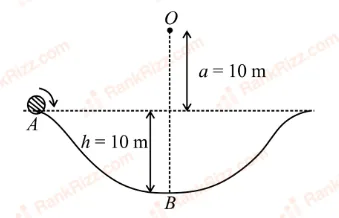
A particle of mass 20 g is released with an initial velocity 5 m s along the curve from the point A, as shown in the figure. The point A is at height h from point B. The particle slides along the frictionless surface. When the particle reaches point B, its angular momentum about O will be: (Take m s)
SOLUTION
Velocity at Point B:
Using conservation of energy between point A and point B:
Angular Momentum about O:
The perpendicular distance from point O to the horizontal velocity vector at B is:
= 10 + 10 = 20 m
Tagged Angular momentum of particles and rigid bodies. Machine-assigned, so read it as a strong shortlist rather than a verdict.