RankRizz
JEE MAIN 2019 · 10 JAN S2+4 / −1MEDIUMTRANSCRIBED

JEE Main 2019 Physics question — Torque and the rotational form of Newton's second law

A rigid massless rod of length 3l3l has two masses attached at each end as shown in the figure. The rod is pivoted at point P on the horizontal axis. When released from the initial horizontal position, its instantaneous angular acceleration will be:
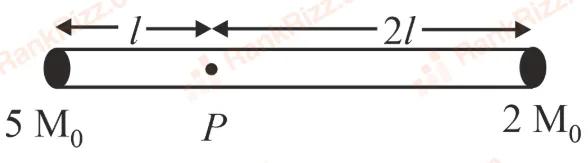
Figure for JEE Main 2019 Physics question on Torque and the rotational form of Newton's second law
SOLUTION

Moment of inertia about pivot PP: I=∑miri2I = \sum m_i r_i^2

I=(5M0)(l)2+(2M0)(2l)2=5M0l2+8M0l2=13M0l2I = (5M_0)(l)^2 + (2M_0)(2l)^2 = 5M_0l^2 + 8M_0l^2 = 13M_0l^2

τnet=∑τi=τ1−τ2\tau_{\text{net}} = \sum \tau_i = \tau_1 - \tau_2

τnet=(5M0g)(l)−(2M0g)(2l)=5M0gl−4M0gl=M0gl\tau_{\text{net}} = (5M_0g)(l) - (2M_0g)(2l) = 5M_0gl - 4M_0gl = M_0gl

τnet=Iα\tau_{\text{net}} = I\alpha

M0gl=(13M0l2)α  ⟹  α=M0gl13M0l2=g13lM_0gl = (13M_0l^2)\alpha \implies \alpha = \frac{M_0gl}{13M_0l^2} = \frac{g}{13l}

Tagged Torque and the rotational form of Newton's second law. Machine-assigned, so read it as a strong shortlist rather than a verdict.

SubjectPhysics
TopicTorque and the rotational form of Newton's second law
TypeMultiple choice