JEE Main 2021 Physics question — Refraction at plane surfaces, Snell's law and apparent depth
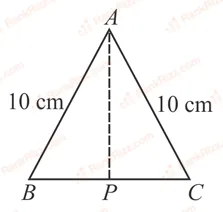
Cross-section view of a prism is the equilateral triangle shown in the figure. The minimum deviation is observed using this prism when the angle of incidence is equal to the prism angle. The time taken by light to travel from P (midpoint of BC) to A is _________ s. (Given, speed of light in vacuum = m s and )
SOLUTION
We need to calculate the time taken by light to travel along the altitude inside an equilateral triangular prism under the given minimum deviation conditions
1. Find the Refractive Index of the Prism ()
For an equilateral triangle prism, the prism angle is:
We are given that at minimum deviation, the angle of incidence () is equal to the prism angle ():
In the condition of minimum deviation, the angle of refraction () inside the prism relates to the prism angle by:
Applying Snell's Law at the first refracting surface:
2. Calculate the Speed of Light Inside the Prism ()
The speed of light inside a medium depends on its refractive index:
3. Determine the Distance Travelled ()
From the given image layout, the side length of the equilateral triangle cross-section is . The point is the midpoint of base , making the altitude of :
4. Calculate the Travel Time ()
Using the uniform motion formula ():
Final Whole Number Answer:
Tagged Refraction at plane surfaces, Snell's law and apparent depth. Machine-assigned, so read it as a strong shortlist rather than a verdict.