JEE Main 2020 Physics question — Refraction at plane surfaces, Snell's law and apparent depth
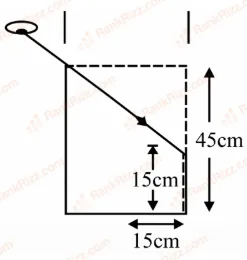
An observer can see through a small hole on the side of a jar (radius 15 cm) at a point at height of 15 cm from the bottom (see figure). The hole is at a height of 45 cm. When the jar is filled with a liquid up to a height of 30 cm the same observer can see the edge at the bottom of the jar. If the refractive index of the liquid is , where N is an integer, the value of N i
SOLUTION
Let us set up a rectangular coordinate frame whose origin is at the inner surface of the wall that contains the hole. The positive -direction is taken horizontally towards the opposite wall and the positive -direction is taken vertically upward. In this frame
Hole (point ):
Bottom edge that finally becomes visible (point ): (the diameter of the jar is ).
First, observe the empty jar. A straight ray travelling through air from the hole reaches the far wall at a point that is only above the bottom. Call this point .
The line joining to therefore represents the extreme ray the observer can follow when the jar is empty. Its equation is obtained in the usual two-point form
Since the numerator is and the denominator is we have
We now fill the jar with liquid up to a height of . Hence the liquid-air interface is the horizontal line
Because everything above the liquid is still air, the incident portion of the extreme ray must still run along the same straight line until it meets the interface. Substituting in gives the intersection point of the ray with the surface:
Thus
The path of the complete ray is therefore
Segment lies in air (refractive index ) and segment lies in the liquid (refractive index , say).
To apply Snell’s law we need the angles the two segments make with the normal to the interface (the normal is vertical). Let the angle of incidence in air be and the angle of refraction in the liquid be .
From simple trigonometry, for segment
The horizontal component is and the vertical component (magnitude) is , so
We therefore have
For segment
Here the horizontal component is and the vertical component (magnitude) is , giving
Hence the refracted angle satisfies
Now we invoke Snell’s law (stated explicitly):
With and we write
Substituting the values already found, we have
Solving for gives
The refractive index is therefore approximately . According to the statement of the problem it can be written as , so
Hence, the correct answer is Option 158.
Tagged Refraction at plane surfaces, Snell's law and apparent depth. Machine-assigned, so read it as a strong shortlist rather than a verdict.