JEE Main 2022 Physics question — Spherical mirrors: mirror formula and magnification
An object 'O' is placed at a distance of 100 cm in front of a concave mirror of radius of curvature 200 cm as shown in the figure. The object starts moving towards the mirror at a speed 2 cm s. The position of the image from the mirror after 10 s will be at _____ cm.
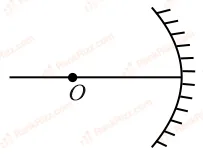
SOLUTION
We need to determine the position of the image formed by a concave mirror after an object 'O' has been moving towards it for 10 seconds.
Step 1: Identify the Initial Mirror Parameters
According to the standard Cartesian sign convention for a concave mirror:
- Radius of curvature () =
- Focal length () =
- Initial object distance () =
Note: Initially, the object is placed exactly at the focal point of the mirror ().
Step 2: Calculate the New Object Position after 10 Seconds
The object moves towards the mirror at a constant speed of .
- Distance traveled by the object in () =
Since the object moves closer to the mirror, its new distance from the pole decreases in magnitude:
Applying the sign convention, the new object distance () is:
Step 3: Calculate the Image Position () Using the Mirror Formula
The relationship between the focal length, object distance, and image distance is given by the mirror formula:
Rearranging the formula to isolate :
Substituting the values ( and ):
Finding a common denominator (400) to simplify the fractions:
Conclusion
The positive sign indicates that a virtual image is formed behind the reflecting surface of the mirror.
Therefore, the position of the image from the mirror after 10 seconds will be at 400 cm.
Tagged Spherical mirrors: mirror formula and magnification. Machine-assigned, so read it as a strong shortlist rather than a verdict.