JEE Main 2022 Physics question — Refraction at plane surfaces, Snell's law and apparent depth
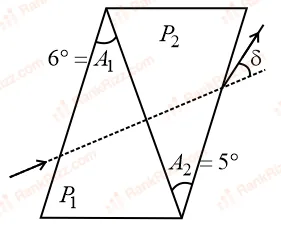
A thin prism of angle and refractive index for yellow light is combined with another prism of angle and . The combination produces no dispersion. The net average deviation produced by the combination is . The value of is _____
SOLUTION
We need to determine the value of given that the net average deviation produced by a combination of two thin prisms is equal to .
1. Identify the Given Parameters
- Angle of the first prism () =
- Refractive index of the first prism for yellow light () =
- Angle of the second prism () =
- Refractive index of the second prism for yellow light () =
2. Understand Deviation Through Thin Prisms
The average (or net) deviation () produced by a single thin prism for mean (yellow) light is given by the formula:
In this non-dispersive setup, the two prisms are placed inverted relative to each other (as shown in the diagram), meaning their individual deviations oppose one another. The net average deviation () is the difference between their individual deviations:
3. Calculate Individual Deviations
First, let's find the deviation produced by the first prism ():
Next, let's find the deviation produced by the second prism ():
4. Calculate Net Average Deviation and Solve for
Subtracting the two values gives the total net deviation of the combination:
We can convert this decimal value into a fractional form to match the format given in the problem statement:
Comparing this result with the expression
Conclusion
The value of is 4.
Tagged Refraction at plane surfaces, Snell's law and apparent depth. Machine-assigned, so read it as a strong shortlist rather than a verdict.