JEE Main 2021 Physics question — Refraction at plane surfaces, Snell's law and apparent depth
A prism of refractive index and another prism of refractive index are stuck together (as shown in the figure). and depend on , the wavelength of light, according to the relation and
The wavelength for which rays incident at any angle on the interface pass through without bending at that interface will be _________ nm.
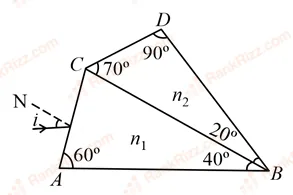
SOLUTION
We need to find the wavelength () for which light rays incident on the interface pass through without bending (no deviation).
1. Condition for No Bending at the Interface
For a light ray to pass through an interface between two optical mediums without shifting or bending at any angle of incidence, the refractive indices of both mediums must be perfectly equal:
2. Equate the Refractive Index Expressions
From the problem details , the equations for and are given as:
Rearrange the terms to group the constant values on one side and the terms on the other:
3. Solve for Wavelength ()
Isolate in the equation:
Taking the square root of both sides gives the value in meters:
Convert the calculated metric value into nanometers ():
Conclusion
The wavelength for which the rays pass through the interface without bending is 600 nm.
```
Tagged Refraction at plane surfaces, Snell's law and apparent depth. Machine-assigned, so read it as a strong shortlist rather than a verdict.