JEE Main 2021 Physics question — Refraction at plane surfaces, Snell's law and apparent depth
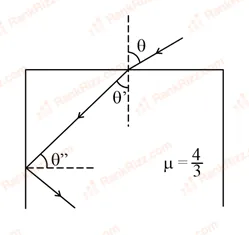
A ray of light entering from air into a denser medium of refractive index , as shown in figure. The light ray suffers total internal reflection at the adjacent surface as shown. The maximum value of angle should be equal to:
SOLUTION
We need to determine the maximum value of the angle of incidence such that the light ray undergoes total internal reflection (TIR) at the adjacent vertical interface.
1. Understand the Path of the Light Ray
From the problem statement:
- The light ray enters from air () into a denser rectangular slab with a refractive index at an angle of incidence .
- Let be the angle of refraction inside the slab at this horizontal surface.
- The ray then travels through the block and hits the adjacent vertical surface. From basic geometry, the angle of incidence at this second vertical wall is .
2. Apply the Condition for Total Internal Reflection
For total internal reflection to occur at the vertical wall boundary with air, the angle of incidence must be greater than or equal to the critical angle ():
To express this in terms of sine, we use the trigonometric identity :
3. Relate to the Initial Boundary (Snell's Law)
Applying Snell's Law at the first horizontal boundary where light enters from air into the medium:
Substitute this expression into our inequality condition from Step 2:
Cancel out the common terms in the denominators:
4. Calculate the Numerical Value
Substitute the given refractive index into the formula to find the maximum angle constraint:
Isolating gives the maximum allowable limit:
Conclusion
The maximum value of the angle must be equal to , which corresponds exactly to Option A.
Tagged Refraction at plane surfaces, Snell's law and apparent depth. Machine-assigned, so read it as a strong shortlist rather than a verdict.