JEE Main 2012 Physics question — Total internal reflection and critical angle
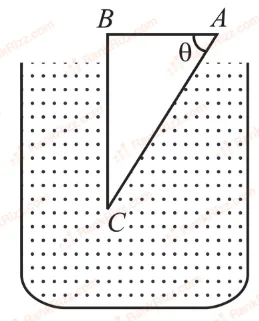
A glass prism of refractive index is immersed in water (refractive index ) as shown in figure. A light beam incident normally on the face is totally reflected to reach the face , if
SOLUTION
Solution & Explanation
Let us analyze the path of the light beam inside the glass prism immersed in water. We are given:
- Refractive index of the glass prism:
- Refractive index of water:
A light beam is incident normally on the face . Because it strikes perpendicular to the surface (), it passes straight into the prism without any deviation and travels directly toward the inclined face .
Let us determine the angle of incidence () at the face using geometry:
- The ray is parallel to the face because it travels straight down perpendicular to .
- From the geometry of the triangle, the angle that this ray makes with the normal to the face is exactly equal to the prism apex angle .
Therefore, the angle of incidence at the glass-water interface on face is:
For the light beam to be totally reflected at the face , the angle of incidence must be strictly greater than the critical angle () for the glass-water boundary:
Taking the sine of both sides preserves the inequality:
According to Snell's Law, the sine of the critical angle when traveling from a denser medium (glass) to a rarer medium (water) is given by the ratio of their refractive indices:
Substitute the given numerical values of the refractive indices:
Substituting this back into our total internal reflection condition inequality gives:
Correct Option Key: Option C ()
Tagged Total internal reflection and critical angle. Machine-assigned, so read it as a strong shortlist rather than a verdict.