JEE Main 2012 Physics question — Total internal reflection and critical angle
A beam of light consisting of red, green and blue colours is incident on a right-angled prism on face . The refractive indices of the material for the above red, green and blue colours are 1.39, 1.44 and 1.47 respectively.
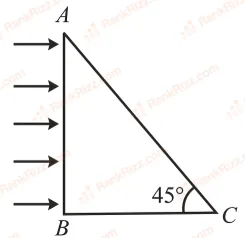
A person looking on surface of the prism will see
SOLUTION
The prism is a right-angled isosceles prism with . The two perpendicular faces are and , while is the hypotenuse.
The mixed beam is incident normally on face , so it enters the prism without refraction and travels in a straight line. Because , the ray that has just entered meets the face making an angle of with the normal to (the angle between the two face normals equals the angle between the faces, i.e. , hence each ray makes with each normal).
Whether the ray escapes or suffers total internal reflection (TIR) at depends on how this compares with the critical angle for each colour.
The critical angle is given by
Calculate for the three colours:
Red:
Green:
Blue:
Compare the actual angle of incidence () with each critical angle:
• For red: incidence is less than the critical angle ⇒ the red ray refracts out through and can be seen.
• For green: incidence exceeds the critical angle ⇒ TIR occurs, so green does not emerge.
• For blue: incidence exceeds the critical angle ⇒ TIR occurs, so blue does not emerge.
Hence only the red component comes out of face . A person looking at that face will therefore see red light alone.
Option D which is: red colour only
Tagged Total internal reflection and critical angle. Machine-assigned, so read it as a strong shortlist rather than a verdict.