JEE Main 2009 Physics question — Total internal reflection and critical angle
A transparent solid cylindrical rod has a refractive index of . It is surrounded by air. A light ray is incident at the mid point of one end of the rod as shown in the figure. The incident angle for which the light ray 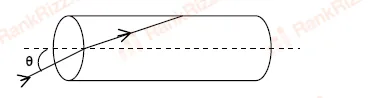 grazes along the wall of the rod is
SOLUTION
The flat circular face of the rod is perpendicular to the axis of the cylinder. Let the light ray strike the centre of this face with an angle of incidence measured from the normal (i.e. from the axis).
1. Refraction at the entry face
Using Snell’s law at the air-rod interface,
Here is the angle that the ray makes with the axis inside the glass rod.
2. Geometry inside the cylinder
Because the ray enters through the centre, its path lies in a plane containing the axis.
Inside the rod the ray travels at an angle to the axis, so its direction can be written as
where is radially outward and is along the axis.
3. Incidence on the curved wall
At the cylindrical wall the normal is purely radial (along ).
The angle of incidence on this wall, say , satisfies
4. Condition for the ray to graze the wall
For the emergent ray to graze the wall, the ray inside must strike the wall at the critical angle , i.e.
The critical angle for glass (refractive index ) to air is
Substituting in equation (2):
5. Obtaining the required incident angle
Insert in equation (1):
Hence the incident angle for which the ray just grazes the cylindrical wall is Option D which is:
Tagged Total internal reflection and critical angle. Machine-assigned, so read it as a strong shortlist rather than a verdict.