JEE Main 2015 Physics question — Thin lenses: lens formula, lens maker's formula and power
A thin convex lens of focal length is put on a plane mirror as shown in the figure. When an object is kept at a distance from the lens-mirror combination, its image is formed at a distance in front of the combination. The value of is:
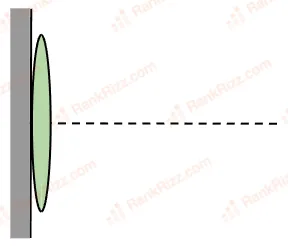
SOLUTION
We start by noting that every ray emerging from the object has to cross the same convex lens twice: once on its way to the plane mirror and once again after reflection. A very convenient way to treat such a situation is to replace the two successive passages through the same lens by a single equivalent thin lens.
The standard result for two thin lenses in contact is stated first:
For two lenses of focal lengths and kept in contact, their combined focal length is given by
In our arrangement the light crosses the same lens twice, so both focal lengths are equal, . Substituting these values we obtain
Hence the lens-mirror combination behaves exactly like a single thin lens whose focal length is .
Next we apply the usual lens formula to this equivalent lens:
The lens formula (Cartesian sign convention) is
where
- is the object distance (measured from the lens; taken negative when the object is on the incident‐light side),
- is the image distance (taken positive when the image is formed on the side opposite to the incident light),
- is the focal length of the equivalent lens.
The object is placed at a distance in front of the combination, i.e. on the side from which light is incident. Therefore
The final image is produced at a distance in front of the combination but on the side of the reflected rays (towards the mirror side). According to the sign convention this position lies on the opposite side of the incident light, so
Substituting in the lens formula we get
Now we carry out every algebraic step carefully.
The left-hand side simplifies to
The first term on the right-hand side is
The second term is
So the right-hand side becomes
Equating the two sides, we have
Cross-multiplying gives
Dividing both sides by 2, we arrive at
Hence, the correct answer is Option A.
Tagged Thin lenses: lens formula, lens maker's formula and power. Machine-assigned, so read it as a strong shortlist rather than a verdict.