RankRizz
JEE MAIN 2016 · 10 APR ONLINE+4 / −1MEDIUMTRANSCRIBED

JEE Main 2016 Physics question — Spherical mirrors: mirror formula and magnification

A hemispherical glass body of radius 10 cm and refractive index 1.5 is silvered on its curved surface. A small air bubble is 6 cm below the flat surface inside it along the axis. The position of the image of the air bubble made by the mirror is seen:
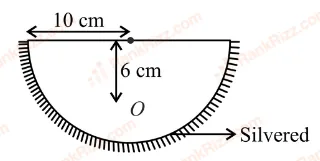
Figure for JEE Main 2016 Physics question on Spherical mirrors: mirror formula and magnification
SOLUTION

The air bubble is 6 cm6\text{ cm} below the flat surface. Since the total radius is 10 cm10\text{ cm}, the bubble is 10−6=4 cm10 - 6 = 4\text{ cm} above the pole. Thus, u=+4 cmu = +4\text{ cm}.

R=+10 cmR = +10\text{ cm} and focal length f=R2=+5 cmf = \frac{R}{2} = +5\text{ cm}

1v+1u=1f\frac{1}{v} + \frac{1}{u} = \frac{1}{f}

1v+14=15\frac{1}{v} + \frac{1}{4} = \frac{1}{5}

1v=15−14=−120\frac{1}{v} = \frac{1}{5} - \frac{1}{4} = -\frac{1}{20}

v=−20 cmv = -20\text{ cm}

The image formed by the mirror is 20 cm20\text{ cm} below the pole (PP).

The light now travels from the mirror's image toward the flat surface to exit into the air.

Real Depth (HH): The image is 20 cm20\text{ cm} below the pole, and the pole is 10 cm10\text{ cm} below the flat surface.

Total real depth from flat surface=20 cm+10 cm=30 cm\text{Total real depth from flat surface} = 20\text{ cm} + 10\text{ cm} = 30\text{ cm}

Light travels from glass (μ=1.5\mu = 1.5) to air. Using the Apparent Depth formula:

Apparent Depth=Real Depthμ\text{Apparent Depth} = \frac{\text{Real Depth}}{\mu}

Apparent Depth=30 cm1.5=20 cm\text{Apparent Depth} = \frac{30\text{ cm}}{1.5} = \mathbf{20\text{ cm}}

Tagged Spherical mirrors: mirror formula and magnification. Machine-assigned, so read it as a strong shortlist rather than a verdict.

SubjectPhysics
TopicSpherical mirrors: mirror formula and magnification
TypeMultiple choice