JEE Main 2025 Physics question — Ampere's circuital law: cylinders, solenoids and toroids
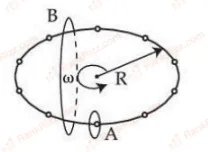
N equally spaced charges each of value q , are placed on a circle of radius R . The circle rotates about its axis with an angular velocity as shown in the figure. A bigger Amperian loop B encloses the whole circle where as a smaller Amperian loop A encloses a small segment. The difference between enclosed currents, , for the given Amperian loops is
SOLUTION
For Amperian loop B:
The loop encloses the entire plane of the rotating circle.
Every charge crossing the loop surface in one direction completes a full loop and crosses back through the enclosed area
For Amperian loop A:
The loop encloses a small segment of the circumference.
The average current due to discrete rotating charges passing through this segment per unit time:
Difference between enclosed currents:
Tagged Ampere's circuital law: cylinders, solenoids and toroids. Machine-assigned, so read it as a strong shortlist rather than a verdict.