RankRizz
JEE MAIN 2012TRANSCRIBED

JEE Main 2012 Physics question — Force on current-carrying conductors and between parallel wires

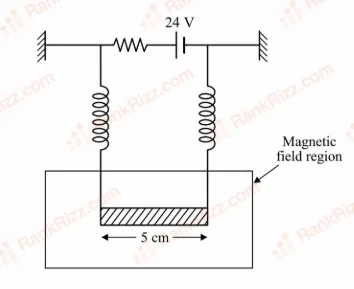
The circuit in figure consists of wires at the top and bottom and identical springs as the left and right sides. The wire at the bottom has a mass of 1010 g and is 55 cm long. The wire is hanging as shown in the figure. The springs stretch 0.50.5 cm under the weight of the wire and the circuit has a total resistance of 12Ω12\Omega. When the lower wire is subjected to a static magnetic field, the springs, stretch an additional 0.30.3 cm. The magnetic field is

Figure for JEE Main 2012 Physics question on Force on current-carrying conductors and between parallel wires
SOLUTION

keq=2kk_{\text{eq}} = 2k

Given: m=10−2 kgm = 10^{-2}\text{ kg}, x1=5×10⁻³ mx_1 = 5 \times 10^{-3}\text{ m}, x2=3×10⁻³ mx_2 = 3 \times 10^{-3}\text{ m}, V=24 VV = 24\text{ V}, R=12 ΩR = 12\ \Omega, l=5×10⁻² ml = 5 \times 10^{-2}\text{ m}

Using initial equilibrium:

mg=keqx1  ⟹  10−2×10=keq×(5×10⁻³)  ⟹  keq=20 N/mmg = k_{\text{eq}}x_1 \implies 10^{-2} \times 10 = k_{\text{eq}} \times (5 \times 10^{-3}) \implies k_{\text{eq}} = 20\text{ N/m}

Using Ohm's law: I=VR=2412=2 AI = \frac{V}{R} = \frac{24}{12} = 2\text{ A}

Using magnetic force for additional stretch: Fm=keqx2  ⟹  IlB=keqx2F_m = k_{\text{eq}}x_2 \implies I l B = k_{\text{eq}}x_2

2×(5×10−2)×B=20×(3×10−3)  ⟹  0.1B=0.06  ⟹  B=0.6 T2 \times (5 \times 10^{-2}) \times B = 20 \times (3 \times 10^{-3}) \implies 0.1B = 0.06 \implies B = 0.6\text{ T}

Using right-hand rule for downward force with leftward current:

F⃗m=I(l⃗×B⃗)  ⟹  −j^=(−i^)×B⃗  ⟹  B⃗=Bk^\vec{F}_m = I(\vec{l} \times \vec{B}) \implies -\hat{j} = (-\hat{i}) \times \vec{B} \implies \vec{B} = B\hat{k}

Tagged Force on current-carrying conductors and between parallel wires. Machine-assigned, so read it as a strong shortlist rather than a verdict.

SubjectPhysics
TopicForce on current-carrying conductors and between parallel wires
TypeMultiple choice