JEE MAIN 2009TRANSCRIBED
JEE Main 2009 Physics question — Ampere's circuital law: cylinders, solenoids and toroids
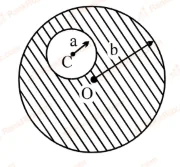
A long straight metal rod has a very long hole of radius drilled parallel to the rod axis as shown in the figure. If the rod carries a current find the value of magnetic induction on the axis of the hole, where OC = c
SOLUTION
Key idea: Superposition: treat the rod with the hole as a full solid rod of current density plus a rod filling the hole carrying .
- Current density: .
- Field inside a solid cylinder at distance from its axis: .
- On the hole's axis (point C): the full rod gives (since ). The negative rod gives zero at its own axis.
- So (The field inside the hole is in fact uniform.)
Answer: (B)
Tagged Ampere's circuital law: cylinders, solenoids and toroids. Machine-assigned, so read it as a strong shortlist rather than a verdict.