JEE Main 2015 Physics question — Magnetic dipole moment of current loops and torque on loops
A wire carrying current is tied between points and and is in the shape of a circular arc of radius due to a uniform magnetic field (perpendicular to the plane of the paper, as shown in the figure) in the vicinity of the wire. If the wire subtends an angle at the center of the circle (of which it forms an arch) then the tension in the wire is:
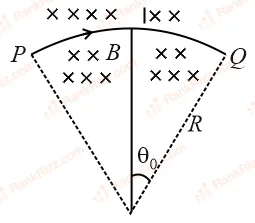
SOLUTION
Consider a small element of the wire subtending an angle at the center. The length of this element is
The magnetic force acting on this element is given by
Since the magnetic field is uniform and perpendicular to the plane of the wire, the magnitude of the force is
Using the Right-Hand Rule, this force acts radially outward from the center.
The components of tension parallel to the tangent at the center of the element cancel out.
The components directed toward the center (radial components) add up.
For the element to be in equilibrium, the net radial force must be zero:
Using the small-angle approximation where for very small angles:
Tagged Magnetic dipole moment of current loops and torque on loops. Machine-assigned, so read it as a strong shortlist rather than a verdict.