JEE Main 2025 Physics question — Motion graphs: x-t, v-t and a-t
Which of the following curves possibly represent one-dimensional motion of a particle ?
Choose the correct answer from the options given below :
SOLUTION
Let’s check each graph using basic rules of 1D motion.
Key idea: for any physical motion, at a given time there must be a unique value of position/velocity/etc. Also, graphs must satisfy physical definitions (like velocity = dx/dt, distance can’t decrease, etc.)
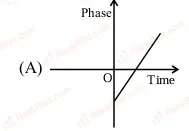
(A) Phase vs Time (straight line)
Phase increasing linearly with time is possible (like uniform motion in SHM phase representation).
No contradiction valid.
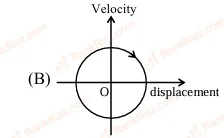
(B) Velocity vs Displacement (circle)
This can represent motion like SHM where
which gives a circular/elliptic relation.
For each displacement, two velocities (forward/backward) are allowed physically valid.
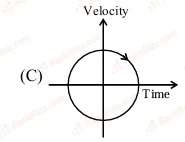
(C) Velocity vs Time (circle)
This is not possible.
At a given time, velocity must have a single value.
But a circle gives two velocities for the same time violates definition.
So invalid.
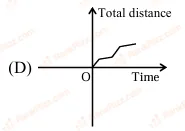
(D) Total distance vs Time
Total distance must:
- always increase (never decrease)
- can be constant temporarily (if particle stops)
The graph shown is non-decreasing valid.
Final answer:
A, B and D only
(C is not possible because it gives multiple velocities at the same time)
Tagged Motion graphs: x-t, v-t and a-t. Machine-assigned, so read it as a strong shortlist rather than a verdict.