JEE Main 2021 Physics question — River-boat, rain-umbrella and wind problems
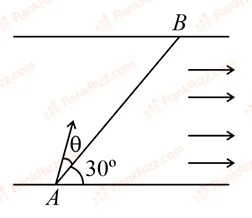
A swimmer wants to cross a river from point to point . Line AB makes an angle of 30° with the flow of the river. The magnitude of the velocity of the swimmer is the same as that of the river. The angle with the line AB should be _________ °, so that the swimmer reaches point .
SOLUTION
We need to determine the angle relative to the line that a swimmer must maintain so that their net resultant path aligns perfectly along .
1. Identify the Motion Vectors
From the problem details and the accompanying vector diagram page:
- The line is the desired path of the swimmer and makes an angle of with the river flow direction.
- Let the velocity of the river be directed horizontally to the right.
- The magnitude of the swimmer's velocity relative to the water () is equal to the magnitude of the river's velocity (). Therefore, we can set .
- The swimmer heads upstream at an angle with respect to the line to counteract the river's push.
2. Analyze Components Perpendicular to the Path AB
For the swimmer to travel directly from point to point , their net velocity component perpendicular to the line must be exactly zero. This means the perpendicular component of the swimmer's velocity relative to the water must perfectly balance the perpendicular component of the river's velocity:
-
River Velocity Component Perpendicular to AB:
The river velocity vector makes an angle of with the line . Its component perpendicular to the line is: -
Swimmer Velocity Component Perpendicular to AB:
The swimmer's velocity vector makes an angle with the line . Its component perpendicular to the line is:
3. Equate and Calculate
Equating both perpendicular components to ensure a straight-line motion along :
Since the magnitudes of both velocities are equal (), we substitute and cancel out from both sides of the equation:
Taking the inverse sine yields:
Conclusion
Double-checking the vector calculation verifies that when the river velocity and swimmer velocity magnitudes are identical, the velocity vectors form a perfect isosceles triangle. This ensures that the heading angle upstream relative to the path matches the path's angle relative to the river bank.
Therefore, the value of is 30.
Tagged River-boat, rain-umbrella and wind problems. Machine-assigned, so read it as a strong shortlist rather than a verdict.