RankRizz
JEE MAIN 2018 · 15 APR S2+4 / −1MEDIUMTRANSCRIBED

JEE Main 2018 Physics question — Kinematics in two dimensions using position vectors

A man in a car at location Q on a straight highway is moving with speed v. He decides to reach a point P in a field at a distance d from highway (point M) as shown in the figure. Speed of the car in the field is half to that on the highway. What should be the distance RM, so that the time taken to reach P is minimum?
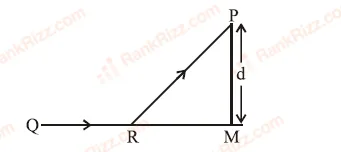
Figure for JEE Main 2018 Physics question on Kinematics in two dimensions using position vectors
SOLUTION

Let the distance RMRM be xx. And let the distance QMQM be LL. We have, PR=x2+d2PR= \sqrt{x^2+d^2}

The total time taken to travel PRPR will be x2+d2v÷2= 2x2+d2v\dfrac{\sqrt{x^2+d^2}}{v\div 2} = \dfrac{2\sqrt{x^2+d^2}}{v}

Time taken to cover the remaining distance L−xL-x from QQ to RR will be L−xv\dfrac{L-x}{v}

Thus, the total time,

T= L−xv+ 2x2+d2vT= \dfrac{L-x}{v} + \dfrac{2\sqrt{x^2+d^2}}{v}

⇒T=L−x+2x2+d2v\Rightarrow T = \dfrac{L-x+2\sqrt{x^2+d^2}}{v}

To minimise time, we will take the derivative of TT with respect to xx, and equate it to 00, we get,

dTdx=ddx[L−x+ 2(x2+d2)1/2v]\dfrac{dT}{dx} = \dfrac{d}{dx}\left[\dfrac{L-x + 2{(x^2+d^2)}^{1/2}}{v}\right]

dTdx=0−1v+2v⋅2x2(x2+d2)−1/2\dfrac{dT}{dx} = 0 - \dfrac{1}{v} + \dfrac{2}{v}\cdot \dfrac{2x}{2}(x^2+d^2)^{-1/2}

⇒dTdx=−1v+2xv⋅(x2+d2)−1/2\Rightarrow \dfrac{dT}{dx} = -\dfrac{1}{v}+ \dfrac{2x}{v}\cdot (x^2+d^2)^{-1/2}

Equating dTdx\dfrac{dT}{dx} to zero to get the minimum value, we have,

2xv⋅(x2+d2)−1/2=1v\dfrac{2x}{v}\cdot (x^2+d^2)^{-1/2} = \dfrac{1}{v}

2xx2+d2=1\dfrac{2x}{\sqrt{x^2+d^2}} = 1

⇒(2x)2=x2+d2\Rightarrow {(2x)}^2 = x^2+d^2

Which gives 3x2=d23x^2 = d^2  or  x=d3x=\dfrac{d}{\sqrt{3}}

Tagged Kinematics in two dimensions using position vectors. Machine-assigned, so read it as a strong shortlist rather than a verdict.

SubjectPhysics
TopicKinematics in two dimensions using position vectors
TypeMultiple choice