RankRizz
JEE MAIN 2019 · 10 APR S2+4 / −1MEDIUMTRANSCRIBED

JEE Main 2019 Physics question — Projectiles from a height and on inclined planes

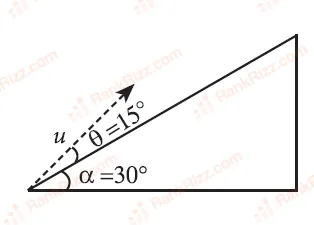
A plane is inclined at an angle α=30\alpha = 30° with respect to the horizontal. A particle is projected with a speed u = 2 m s−1^{-1}, from the base of the plane, making an angle θ=15\theta = 15° with respect to the plane as shown in the figure. The distance from the base, at which the particle hits the plane is close to: (Take g = 10 m s−210\ m \ s^{-2})

Figure for JEE Main 2019 Physics question on Projectiles from a height and on inclined planes
SOLUTION

To find the distance from the base at which the particle hits the inclined plane (the range along the incline, RR), we can break down the motion parallel and perpendicular to the inclined surface.

Here is the step-by-step formatting and solution of your approach.

1. Given Data

  • Angle of inclination of the plane: α=30∘\alpha = 30^\circ
  • Angle of projection relative to the plane: θ=15∘\theta = 15^\circ
  • Initial velocity: u=2 m s−1u = 2\text{ m s}^{-1}
  • Acceleration due to gravity: g=10 m s−2g = 10\text{ m s}^{-2}
  • ux=ucos⁡θ=2cos⁡15∘u_x = u \cos\theta = 2 \cos 15^\circ
  • uy=usin⁡θ=2sin⁡15∘u_y = u \sin\theta = 2 \sin 15^\circ
  • ax=−gsin⁡α=−10sin⁡30∘a_x = -g \sin\alpha = -10 \sin 30^\circ
  • ay=−gcos⁡α=−10cos⁡30∘a_y = -g \cos\alpha = -10 \cos 30^\circ

2. Components of Motion

By choosing the xx-axis along the inclined plane (upwards) and the yy-axis perpendicular to the inclined plane:

Initial Velocity Components

Acceleration Components

3. Calculation of Time of Flight (TT)

The particle returns to the inclined plane when its displacement perpendicular to the plane is zero (y=0y = 0):

y=uyT+12ayT2=0y = u_y T + \frac{1}{2} a_y T^2 = 0

(2sin⁡15∘)T−12(gcos⁡30∘)T2=0(2 \sin 15^\circ) T - \frac{1}{2} (g \cos 30^\circ) T^2 = 0

Solving for non-zero time TT:

T=2usin⁡θgcos⁡α=2×2sin⁡15∘10cos⁡30∘T = \frac{2 u \sin\theta}{g \cos\alpha} = \frac{2 \times 2 \sin 15^\circ}{10 \cos 30^\circ}

4. Range Along the Incline (RR)

The displacement along the incline is given by:

R=uxT+12axT2R = u_x T + \frac{1}{2} a_x T^2

Substituting ux=2cos⁡15∘u_x = 2 \cos 15^\circ and ax=−gsin⁡30∘a_x = -g \sin 30^\circ:

R=(2cos⁡15∘)T−12(10sin⁡30∘)T2R = (2 \cos 15^\circ) T - \frac{1}{2} (10 \sin 30^\circ) T^2

Alternative Standard Formula

Instead of plugging numbers into both terms manually, we can use the simplified standard formula for the range up an inclined plane:

R=2u2sin⁡θcos⁡(θ+α)gcos⁡2αR = \frac{2 u^2 \sin\theta \cos(\theta + \alpha)}{g \cos^2\alpha}

Substituting the values into this formula makes it much cleaner:
R=2×(2)2×sin⁡15∘×cos⁡(15∘+30∘)10×cos⁡230∘R = \frac{2 \times (2)^2 \times \sin 15^\circ \times \cos(15^\circ + 30^\circ)}{10 \times \cos^2 30^\circ}

R=8×sin⁡15∘×cos⁡45∘10×(32)2R = \frac{8 \times \sin 15^\circ \times \cos 45^\circ}{10 \times \left(\frac{\sqrt{3}}{2}\right)^2}

R=8×sin⁡15∘×1210×34=32sin⁡15∘302R = \frac{8 \times \sin 15^\circ \times \frac{1}{\sqrt{2}}}{10 \times \frac{3}{4}} = \frac{32 \sin 15^\circ}{30\sqrt{2}}

Using the known value sin⁡15∘=3−122\sin 15^\circ = \frac{\sqrt{3}-1}{2\sqrt{2}}:

R=32×(3−1)30×2×2×2=32(3−1)120=4(3−1)15 metersR = \frac{32 \times (\sqrt{3} - 1)}{30 \times 2 \times \sqrt{2} \times \sqrt{2}} = \frac{32(\sqrt{3}-1)}{120} = \frac{4(\sqrt{3}-1)}{15}\text{ meters}

5. Final Numeric Approximation

Using 3≈1.732\sqrt{3} \approx 1.732:

R≈4×(1.732−1)15=4×0.73215=2.92815≈0.1952 mR \approx \frac{4 \times (1.732 - 1)}{15} = \frac{4 \times 0.732}{15} = \frac{2.928}{15} \approx 0.1952\text{ m}

Converting meters to centimeters:

R≈0.1952×100 cm=19.52 cm≈20 cmR \approx 0.1952 \times 100\text{ cm} = 19.52\text{ cm} \approx 20\text{ cm}

Correct Answer: A (20 cm)

Tagged Projectiles from a height and on inclined planes. Machine-assigned, so read it as a strong shortlist rather than a verdict.

SubjectPhysics
TopicProjectiles from a height and on inclined planes
TypeMultiple choice