JEE Main 2022 Physics question — Connected bodies, pulleys and constraint relations
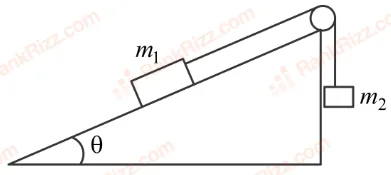
Two bodies of masses kg and kg are connected by a light string going over a smooth light pulley on a smooth inclined plane as shown in the figure. The system is at rest. The force exerted by the inclined plane on the body of mass will be: [Take m s]
SOLUTION
Now here we have 2 bodies of masses and
Let us consider the forces acting on these
On the forces acting are
As they are in opposite directions and for the system to be in equilibrium, they have to be equal
coming to the first body of mass
Forces along the direction of incline are T\ and\ F_{ }=\ m_1g\sin\theta\
These are also equal as the system is in equilibrium
So , T\ =m_1g\sin\theta\
We know ,
After Substituting T
Now coming to Forces which are perpendicular to the incline
N\ and\ m_1g\cos\theta\
Even they have to equal
so , N\ =\ m_1g\cos\theta\
As \sin\theta\ =\frac{3}{5}\ then\ \cos\ \theta\ =\frac{4}{5}\
Then
This is the force exerted by the inclined plane on the body of mass
Tagged Connected bodies, pulleys and constraint relations. Machine-assigned, so read it as a strong shortlist rather than a verdict.