JEE Main 2022 Physics question — Connected bodies, pulleys and constraint relations
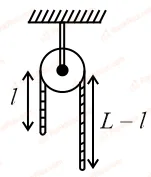
A uniform metal chain of mass and length passes over a massless and frictionless pulley. It is released from rest with a part of its length is hanging on one side and rest of its length is hanging on the other side of the pulley. At a certain point of time, when , the acceleration of the chain is . The value of is
SOLUTION
1. Identify the Forces acting on the Chain
Let the linear mass density of the chain be λ. Since the chain is uniform, it is given by:
At the given point in time:
- The length of the chain hanging on one side is l. The mass of this section is m1 = λl.
- The length of the chain hanging on the other side is L - l. The mass of this section is m2 = λ(L - l).
Assuming the longer side (L - l) moves downward, the net driving force (Fnet) on the chain is the difference between the gravitational forces acting on both sides:
2. Formulate the Acceleration Equation
The total mass being accelerated is the entire mass of the chain, m = λL.
Using Newton's second law (Fnet = m · a):
3. Substitute the Given Values
We are given that when l = L / x, the acceleration of the chain is a = g / 2. Substituting these into our acceleration equation:
Cancel out g from both sides:
Rearranging the terms to solve for x:
Conclusion
The value of x is 4. Therefore, the correct option is 4.
```
Tagged Connected bodies, pulleys and constraint relations. Machine-assigned, so read it as a strong shortlist rather than a verdict.