JEE Main 2022 Physics question — Connected bodies, pulleys and constraint relations
Three masses , and are arranged in a system as shown in figure. All the surfaces are frictionless and strings are inextensible and weightless. The pulleys are also weightless and frictionless. A force is applied on the system so that the mass moves upward with an acceleration of . The value of is (Take )
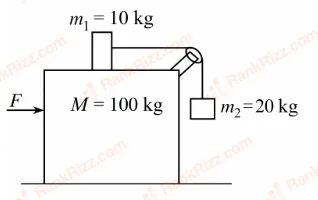
SOLUTION
Given values:
Mass
Mass
Mass
Upward acceleration of mass ,
Acceleration due to gravity,
1. Motion of relative to the wedge :
For mass to move upward relative to the block/wedge with an acceleration , mass must move to the right relative to with the same relative acceleration (since the string is inextensible).
2. Equation for mass in the vertical direction:
The vertical forces acting on are tension pulling upward and weight pulling downward:
$
$
3. Horizontal motion of in the frame of reference of wedge :
Let the horizontal acceleration of the whole system (the wedge ) to the right be .
In the non-inertial reference frame of the wedge moving rightward with acceleration , a pseudo force acts to the left on .
The equation of motion for along the horizontal direction relative to the wedge is:
$
Substitute the known values:
$
$
4. Total Applied Force :
Considering the entire , both having same acceleration in x direction
The value of is 3360 N
Tagged Connected bodies, pulleys and constraint relations. Machine-assigned, so read it as a strong shortlist rather than a verdict.