JEE Main 2012 Physics question — Static and kinetic friction
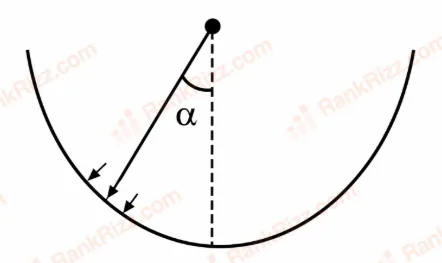
An insect crawls up a hemispherical surface very slowly. The coefficient of friction between the insect and the surface is . If the line joining the centre of the hemispherical surface to the insect makes an angle with the vertical, the maximum possible value of so that the insect does not slip is given by
SOLUTION
Solution & Explanation
1. Identify the Forces Acting on the Insect
Let the insect be at a point on the hemispherical surface where the radius vector from the center makes an angle with the vertical. Let us resolve the forces acting on the insect along and perpendicular to the tangential surface at that point:
- Weight (): Acts vertically downward.
- The component acting perpendicular to the spherical surface (along the normal radius) is .
- The component acting tangentially downward (tending to make the insect slide) is .
- Normal Reaction (): Acts radially outward from the surface, balancing the perpendicular gravitational component:
- Frictional Force (): Acts tangentially upward along the surface to oppose the sliding tendency:
2. Apply the Limiting Condition for Equilibrium
For the insect to climb safely without slipping, the required static friction force must be less than or equal to the maximum available limiting friction ():
Substitute our expressions for and into the inequality:
mg \cdot \sin\alpha \le \mu \cdot (mg \cdot \cos\alpha)
Canceling out the weight () from both sides gives:
3. Calculate the Maximum Angle Using the Given Coefficient
The maximum possible angle before slipping occurs happens at the limiting condition where . We are given the coefficient of friction as :
Since , we invert both sides of the equation:
Concept Check: As the insect crawls higher up the dome, the incline gets steeper, which causes the destabilizing parallel component () to increase while the stabilizing normal grip force () simultaneously decreases. The threshold where these opposing changes cross over is strictly limited by the traction coefficient ().
Correct Option Key: Option A ()
Tagged Static and kinetic friction. Machine-assigned, so read it as a strong shortlist rather than a verdict.