JEE Main 2004 Physics question — Pseudo force: lifts and accelerating frames
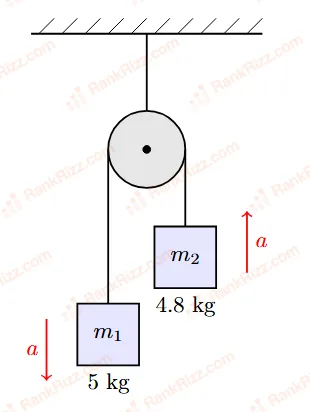
Two masses kg and kg tied to a string are hanging over a light frictionless pulley. What is the acceleration of the masses when lift free to move ?
SOLUTION
Let be the tension in the string and be the common acceleration of the system.
Since , the heavier mass will accelerate downwards, and the lighter mass will accelerate upwards.
Applying Newton's Second Law () to each mass, we get the following equations of motion:
For mass (accelerating downwards):
For mass (accelerating upwards):
To find the acceleration, we can add Equation 1 and Equation 2 to eliminate the tension variable :
Now, rearrange the formula to solve for acceleration :
Substitute the given numerical values into the derived formula:
The in the numerator and denominator cancel out:
Tagged Pseudo force: lifts and accelerating frames. Machine-assigned, so read it as a strong shortlist rather than a verdict.