JEE Main 2021 Physics question — Static and kinetic friction
A boy of mass 4 kg is standing on a piece of wood having mass 5 kg. If the coefficient of friction between the wood and the floor is 0.5, the maximum force that the boy can exert on the rope so that the piece of wood does not move from its place is ________ N. (Round off to the Nearest Integer) [Take m s]
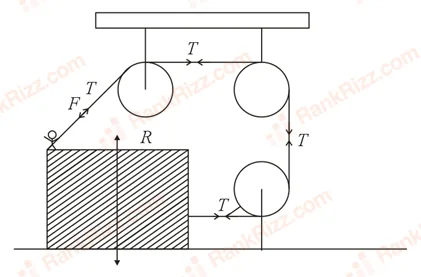
SOLUTION
We need to determine the maximum force (tension ) that the boy can exert on the rope so that the piece of wood remains at rest on the floor.
1. Identify the Forces acting on the Boy
Let the tension in the rope held by the boy be . The forces acting vertically on the boy (mass ) are:
- The downward gravitational force:
- The upward normal reaction force from the wood surface:
- The upward pulling force from the rope: (since the rope pulls the boy upwards as he pulls down on it)
For vertical equilibrium of the boy:
2. Identify the Forces acting on the Piece of Wood
Let's look at the forces acting on the piece of wood (mass ):
- Vertical Forces:
- Downward gravitational force:
- Downward normal pressing force from the boy:
- Upward normal reaction force from the floor:
For vertical equilibrium of the wood:
Substitute from Equation 1 into this expression:
- Horizontal Forces:
- Based on the pulley system shown in the diagram , the tension pulls the piece of wood horizontally to the right.
- The limiting static frictional force () from the floor opposes this motion by acting to the left:
3. Set up the Condition for No Movement
For the wood to stay in its place, the horizontal pulling force () must not exceed the maximum limiting friction ():
Substitute the value of coefficient of friction () and the normal force expression from Equation 2:
Conclusion
The maximum force that the boy can exert on the rope so that the piece of wood does not move is 30 N.
Tagged Static and kinetic friction. Machine-assigned, so read it as a strong shortlist rather than a verdict.