JEE Main 2021 Physics question — Static and kinetic friction
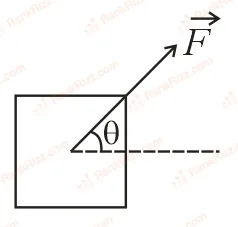
A block of mass slides along a floor while a force of magnitude is applied to it at an angle as shown in figure. The coefficient of kinetic friction is . Then, the block's acceleration is given by: ( is acceleration due to gravity)
SOLUTION
```html
Solution & Explanation
Let us resolve the applied force acting on the block of mass into its orthogonal vector components. The force is applied at an angle relative to the horizontal surface:
- Horizontal component (): Drives the block forward along the floor.
- Vertical component (): Pushes the block downward, directly increasing the contact pressure with the floor.
To find the normal reaction force () exerted by the ground, we set up the static equilibrium equation along the vertical axis where there is no net motion:
The kinetic friction force () opposing the forward sliding motion of the block depends directly on this normal reaction force:
Applying Newton's Second Law along the horizontal axis of motion yields the net force equation:
To explicitly solve for the block's acceleration (), divide the entire expression by the mass :
Concept Check: Because the external force pushes downward at an angle, it actively presses the block tighter into the floor. This structural alignment augments the standard normal force from to , ramping up the kinetic friction drag and reducing the net forward acceleration to exactly .
Correct Option Choice: Option C
```
Tagged Static and kinetic friction. Machine-assigned, so read it as a strong shortlist rather than a verdict.