JEE Main 2021 Physics question — Gravitational potential energy of systems
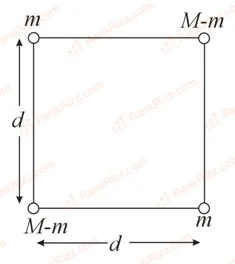
A body of mass splits into four masses , which are rearranged to form a square as shown in the figure. The ratio of for which, the gravitational potential energy of the system becomes maximum is . The value of is _________.
SOLUTION
1. Understand the System Configuration
Let the four masses be placed at the corners of a square of side in a cyclic order:
- Corner 1:
- Corner 2:
- Corner 3:
- Corner 4:
The distance between adjacent corners is , and the distance between diagonally opposite corners is .
2. Write the Expression for Total Gravitational Potential Energy ()
The total gravitational potential energy of a system of particles is the sum of the potential energies of all unique pairs:
Let's calculate the interactions by grouping them by distance:
- Four Adjacent Pairs (at distance ):
- Between Corner 1 and Corner 2:
- Between Corner 2 and Corner 3:
- Between Corner 3 and Corner 4:
- Between Corner 4 and Corner 1:
- Two Diagonal Pairs (at distance ):
- Between Corner 1 and Corner 3 (both mass ):
- Between Corner 2 and Corner 4 (both mass ):
Combining all pairs, the total potential energy expression is:
3. Maximize the Potential Energy
Since gravitational potential energy is a negative quantity, maximizing the potential energy means making its absolute magnitude minimum, or directly finding the critical point where .
Let's differentiate the expression inside the bracket with respect to and set it to zero:
Performing the differentiation step-by-step:
4. Determine the Ratio
Factor out on the left side and on the right side:
Notice that the right side can be factored further by pulling out a :
Canceling out the common term from both sides gives:
Given that the ratio , we find that .
Final Answer: 2
Tagged Gravitational potential energy of systems. Machine-assigned, so read it as a strong shortlist rather than a verdict.