JEE Main 2021 Physics question — Screw gauge: pitch, least count and zero error
Student A and student B used two screw gauges of equal pitch and 100 equal circular divisions to measure the radius of a given wire. The actual value of the radius of the wire is 0.322 cm. The absolute value of the difference between the final circular scale readings observed by the students A and B is ___.
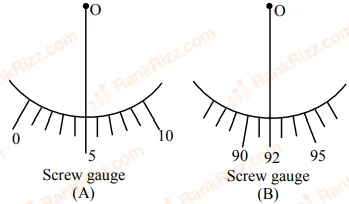
Given pitch = 0.1 cm.
SOLUTION
We need to determine the absolute value of the difference between the final circular scale readings observed by student A and student B when measuring the radius of a wire.
1. Calculate the Least Count (LC) of the Screw Gauges
From the problem page, both screw gauges have the same pitch and total number of circular divisions:
- Pitch =
- Number of circular divisions =
The least count () is calculated as:
2. Determine the Initial Zero Errors
Looking at the provided reference diagrams, we can determine the initial zero error for each student's instrument based on where the zero mark lies relative to the reference line:
-
Screw Gauge A:
The division coincides with the reference line when the studs are closed, meaning it has a positive zero error: -
Screw Gauge B:
The division coincides with the reference line. Since it is below the zero mark ( divisions behind), it has a negative zero error:
3. Relate Observed Readings to Actual Value
The true radius value is given as . The general formula for a measurement is:
Where represents the final circular scale reading. Let's express this for both students:
-
For Student A:
-
For Student B:
Since both gauges have a pitch of , the pitch/main scale reading () must be identical for measuring the same object (). Let's solve for the exact circular scale divisions ($):
4. Calculate the Absolute Difference
Finally, find the absolute difference between the two circular scale readings ( and ):
Conclusion
The absolute value of the difference between the final circular scale readings observed by the students is 13.
Tagged Screw gauge: pitch, least count and zero error. Machine-assigned, so read it as a strong shortlist rather than a verdict.