JEE MAIN 2014 · 19 APR ONLINE+4 / −1MEDIUMTRANSCRIBED
JEE Main 2014 Physics question — Mechanics and thermal experiments: pendulum, Searle, capillary, Stokes, calorimetry, resonance tube
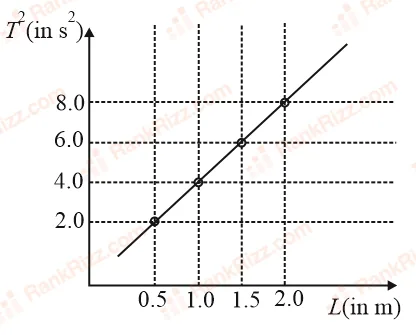
In an experiment to determine the gravitational acceleration g of a place with the help of a simple pendulum, the measured time period squared is plotted against the string length of the pendulum in the figure. What is the value of g at the place?
SOLUTION
This equation represents a straight line passing through the origin in a vs graph, where the slope is
Tagged Mechanics and thermal experiments: pendulum, Searle, capillary, Stokes, calorimetry, resonance tube. Machine-assigned, so read it as a strong shortlist rather than a verdict.