JEE Main 2023 Physics question — Electric field of continuous charge distributions
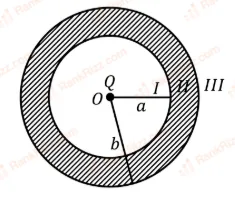
As shown in the figure, a point charge is placed at the centre of conducting spherical shell of inner radius and outer radius . The electric field in three different regions I, II and III is given by:
(I: , II: , III: )
SOLUTION
For a point charge Q placed at the centre of a conducting spherical shell:
Regions are:
- Region I:r<a(inside cavity)
- Region II: a<r<b (inside conducting material)
- Region III: r>b (outside shell)
We examine electric field in each region.
For Region I (r<a)
Using Gauss law, take a spherical Gaussian surface of radius r<ar
Only charge enclosed is Q.
Since symmetry makes E constant over the surface,
For Region II (a<r<b):
This is the conducting material.
In electrostatic equilibrium, electric field inside a conductor is zero.
This happens because charge Q induces
- charge −Q on inner surface
- charge +Q on outer surface
so field inside the conductor cancels.
For Region III (r>b):
Take a Gaussian sphere of radius r>b.
Total enclosed charge is
Using Gauss law,
So field outside is not zero; the whole system behaves like a point charge Q at the centre.
Therefore,
Correct option:
B
Tagged Electric field of continuous charge distributions. Machine-assigned, so read it as a strong shortlist rather than a verdict.