JEE Main 2010 Physics question — Electric field of continuous charge distributions
A thin semi-circular ring of radius r has a positive charge q distributed uniformly over it. The net field E at the centre O is
SOLUTION
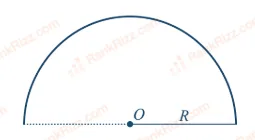
Let the thin semi-circular ring lie in the x-y plane with its centre at the origin O(0,0) and radius r. The two ends of the semicircle meet the x-axis at (−r,0) and (+r,0), so every point on the ring has positive y-coordinate.
The total positive charge distributed uniformly over the arc is q.
Linear charge density λ is therefore
λ=length of arctotal charge=πrq
Choose an element of length dl at the polar angle α measured from the +x-axis (see figure in mind).
Coordinates of the element: (rcosα,rsinα) where 0≤α≤π.
Charge of the element
dq=λdl=λrdα
Magnitude of the electric field produced at the centre by this element:
dE=4πε01r2dq
The field vector points radially inward (towards the centre) because the observation point is on the line joining the charge element to the centre.
The unit vector along this inward radial direction is r^in=(−cosα,−sinα).
Hence the y-component contributed by the element is
dEy=dE(component of r^in along −j^)=dE(−sinα)=−4πε01r2dqsinα
Substituting dq=λrdα:
dEy=−4πε01r2λrdαsinα=−4πε0rλsinαdα
Integrate over the entire semicircle (from α=0 to α=π):
Ey=∫0πdEy=−4πε0rλ∫0πsinαdα
The integral evaluates to
∫0πsinαdα=[−cosα]0π=−cosπ+cos0=2
Therefore
Ey=−4πε0rλ(2)=−4πε0r2λ
Insert λ=πrq:
Ey=−4πε0r2πrq=−2π2ε0r2q
All horizontal (x) components cancel by symmetry, so the net field is purely along −j^ (negative y-direction).
Hence,
Ecentre=−2π2ε0r2qj^
Option C which is: −2π2ε0r2qj^
Tagged Electric field of continuous charge distributions. Machine-assigned, so read it as a strong shortlist rather than a verdict.