JEE Main 2007 Physics question — Electric field due to point charges and superposition
Charges are placed on the vertices of a square as shown. Let be the electric field and the potential at the centre. If the charges on and are interchanged with those on and respectively, then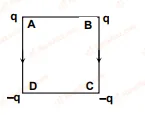
SOLUTION
Let the centre of the square be and the side of the square be . Choose Cartesian axes through so that the four vertices have co-ordinates
The distance of every vertex from the centre is the same,
Hence all four charges are equidistant from .
Denote the initial charges by placed at respectively.
Potential at the centre (before interchange)
Using the superposition principle, the electric potential at a point is the algebraic sum of the potentials due to individual charges because potential is a scalar. Therefore
where
Electric field at the centre (before interchange)
For any vertex the magnitude of the field at is
and its direction is along the line joining that vertex to the centre (outward for a positive charge, inward for a negative one). Writing the four position vectors from to the vertices,
the electric field at is
where each is the unit vector along .
Interchange of charges
The question says: “charges on and are interchanged with those on and respectively.”
In symbols this means
After interchange, the charges occupying the vertices become
Potential after interchange
Because the distance is unchanged and the potential is a scalar sum, the new potential is
Hence the electric potential at the centre does not change.
Electric field after interchange
The magnitudes are the same as before, but the charges now multiply different direction vectors:
In general unless the pairs and already happened to be equal. Therefore the electric field changes.
Conclusion
The interchange leaves the potential unchanged but alters the electric field.
Option D which is: changes, remains unchanged.
Tagged Electric field due to point charges and superposition. Machine-assigned, so read it as a strong shortlist rather than a verdict.