RankRizz
JEE MAIN 2020 · 08 JAN S1+4 / −1MEDIUMTRANSCRIBED

JEE Main 2020 Physics question — Magnetic flux, Faraday's law and Lenz's law

At time t=0t = 0 magnetic field of 1000 Gauss is passing perpendicularly through the area defined by the closed loop shown in the figure. If the magnetic field reduces linearly to 500 Gauss, in the next 5s, then induced EMF in the loop is:
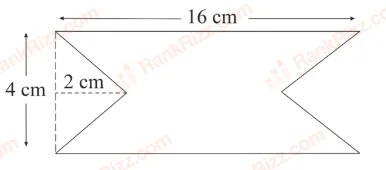
Figure for JEE Main 2020 Physics question on Magnetic flux, Faraday's law and Lenz's law
SOLUTION

Minimum Required Theory 

  • Faraday’s Law of Electromagnetic Induction: The magnitude of the induced electromotive force (ε\varepsilon) in a closed loop equals the rate of change of magnetic flux (Φ\Phi) through the loop:
  • Unit Conversions:
    • o Area: 1 cm2=10−4 m21\text{ cm}^2 = 10^{-4}\text{ m}^2
  • o Magnetic Field: 1 Gauss (G)=10−4 Tesla (T)1\text{ Gauss (G)} = 10^{-4}\text{ Tesla (T)}
  • o Induced EMF: 1 μV=10−6 V1\text{ }\mu\text{V} = 10^{-6}\text{ V}
  • Area of large rectangle =16 cm×4 cm=64 cm2= 16\text{ cm} \times 4\text{ cm} = 64\text{ cm}^2
  • Area of inner cut-out =4 cm×2 cm=8 cm2= 4\text{ cm} \times 2\text{ cm} = 8\text{ cm}^2

ε=ΔΦΔt=AΔBΔt\varepsilon = \frac{\Delta \Phi}{\Delta t} = A \frac{\Delta B}{\Delta t}

Step-by-Step Solution

Step 1: Calculate the effective area (AA) of the closed loop

The geometry consists of a large main rectangle from which a smaller inner rectangular section has been subtracted (or indented).

Net Area A=64 cm2−8 cm2=56 cm2\text{Net Area } A = 64\text{ cm}^2 - 8\text{ cm}^2 = 56\text{ cm}^2

Convert the area to SI units (m2\text{m}^2):

A=56×10−4 m2A = 56 \times 10^{-4}\text{ m}^2

Step 2: Determine the rate of change of the magnetic field (ΔBΔt\frac{\Delta B}{\Delta t})

The magnetic field decreases linearly from 1000 G1000\text{ G} to 500 G500\text{ G} over a time interval Δt=5 s\Delta t = 5\text{ s}.

ΔB=1000 G−500 G=500 G\Delta B = 1000\text{ G} - 500\text{ G} = 500\text{ G}

Convert ΔB\Delta B to Tesla (T):

ΔB=500×10−4 T\Delta B = 500 \times 10^{-4}\text{ T}

Now, calculate the rate of change:

ΔBΔt=500×10−4 T5 s=100×10−4 T/s\frac{\Delta B}{\Delta t} = \frac{500 \times 10^{-4}\text{ T}}{5\text{ s}} = 100 \times 10^{-4}\text{ T/s}

Step 3: Compute the induced EMF (ε\varepsilon)

Substitute the values into Faraday's formula:

ε=A×ΔBΔt\varepsilon = A \times \frac{\Delta B}{\Delta t}

ε=(56×10−4 m2)×(100×10−4 T/s)\varepsilon = (56 \times 10^{-4}\text{ m}^2) \times (100 \times 10^{-4}\text{ T/s})

ε=5600×10−8 V\varepsilon = 5600 \times 10^{-8}\text{ V}

ε=56×10−6 V\varepsilon = 56 \times 10^{-6}\text{ V}

Step 4: Convert to microvolts (μV\mu\text{V})

Since 10−6 V=1 μV10^{-6}\text{ V} = 1\text{ }\mu\text{V}:

ε=56 μV\varepsilon = 56\text{ }\mu\text{V}

Final Answer

The induced EMF in the loop is 56 μV56\text{ }\mu\text{V}.

Tagged Magnetic flux, Faraday's law and Lenz's law. Machine-assigned, so read it as a strong shortlist rather than a verdict.

SubjectPhysics
TopicMagnetic flux, Faraday's law and Lenz's law
TypeMultiple choice