JEE Main 2019 Physics question — Motional emf in moving rods and loops
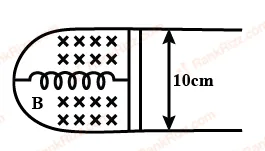
A thin strip 10 cm long is on a U shaped wire of negligible resistance and it is connected to a spring of spring constant 0.5 N m (see figure). The assembly is kept in a uniform magnetic field of 0.1 T. If the strip is pulled from its equilibrium position and released, the number of oscillations it performs before its amplitude decreases by a factor of e is N. If the mass of the strip is 50 grams, its resistance 10 and air drag negligible, N will be close to:
SOLUTION
We have a conducting strip of length sliding on friction-free rails that form a closed circuit of total resistance . The strip is free to move along the rails while a uniform magnetic field of magnitude is directed perpendicular to the plane of the circuit. A light spring of force constant pulls the strip towards its equilibrium position. The mass of the strip is . Air drag is negligible, so the only damping is electromagnetic.
Whenever the strip moves with velocity , the motional emf produced across its ends is given by Faraday’s law of electromagnetic induction,
Ohm’s law then gives the induced current,
The magnetic force on a current-carrying conductor of length in a field is (in magnitude)
Substituting the expression for , we obtain
This force always opposes the velocity (Lenz’s law), so it behaves exactly like a viscous damping force of the form with an effective electromagnetic damping coefficient
Putting in the numerical values,
The strip-spring system therefore obeys the equation for a damped harmonic oscillator,
For small damping (which is true here because is very small) the displacement amplitude decays exponentially as
The time constant for the amplitude to fall by a factor of is therefore
Meanwhile the natural period of oscillation (with weak damping the change in period is negligible) follows from
The number of oscillations completed in a time is , so the number of oscillations completed in one time constant is
Now we substitute every numerical value step by step.
First,
Next, recalling , we have
Because we merely need a value “close to” the answer, we round to the nearest option offered. is closest to
Hence, the correct answer is Option B.
Tagged Motional emf in moving rods and loops. Machine-assigned, so read it as a strong shortlist rather than a verdict.