JEE Main 2015 Physics question — LR circuits: growth and decay of current
An LCR circuit is equivalent to a damped pendulum. In an LCR circuit the capacitor is charged to and then connected to the L and R as shown below:
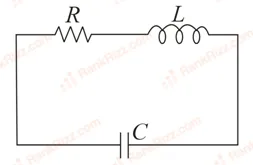
If a student plots graphs of the square of maximum charge on the capacitor with time (t) for two different values and () of L then which of the following represents this graph correctly? (plots are schematic and not drawn to scale)
SOLUTION
The discharging of a capacitor in a series LCR circuit is analogous to a damped harmonic oscillator, such as a damped pendulum. The resistor acts as the damping element, dissipating energy and causing the amplitude of the charge to decay exponentially over time.
The maximum charge on the capacitor at any time represents the envelope of the damped oscillation:
A larger inductance results in a smaller decay constant (), meaning the charge amplitude decreases more slowly (slower decay).
Given that , the decay for is slower than for . Consequently, for any time , the curve for will remain at a higher value than the curve for .
Tagged LR circuits: growth and decay of current. Machine-assigned, so read it as a strong shortlist rather than a verdict.