JEE Main 2021 Physics question — Motional emf in moving rods and loops
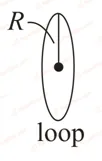
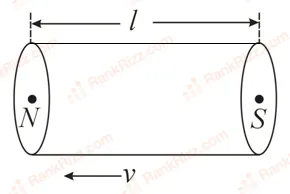
A bar magnet is passing through a conducting loop of radius with velocity . The radius of the bar magnet is such that it just passes through the loop. The induced e.m.f. in the loop can be represented by the approximate curve:
SOLUTION
We need to determine the approximate curve representing the induced electromotive force (e.m.f.) in a conducting loop as a bar magnet passes completely through it with a constant velocity .
1. Understand the Physics Principles (Faraday's Law & Lenz's Law)
According to Faraday's Law of Electromagnetic Induction, the magnitude of the induced e.m.f. () in a loop is directly proportional to the rate of change of magnetic flux () through it:
The negative sign is a mathematical statement of Lenz's Law, which states that the induced current will flow in a direction that opposes the change in magnetic flux that produced it.
2. Analyze the Journey of the Bar Magnet
Let's divide the movement of the bar magnet through the loop into three distinct chronological phases:
- Phase 1: The Magnet Approaches the Loop (North Pole Entering)
As the North pole of the magnet moves closer to the loop, the magnetic flux linked with the loop increases (). To oppose this increase, an e.m.f. is induced in one direction (let's consider this direction negative or positive, depending on orientation). The e.m.f. grows from zero to a peak value, and then decreases back to zero as the center of the magnet aligns with the loop.
- Phase 2: The Magnet is Completely Inside the Loop
When the magnet is fully inside the loop and moving uniformly, the number of magnetic field lines entering the loop is equal to the number of field lines leaving it. Consequently, the total magnetic flux remains constant (), and the induced e.m.f. drops momentarily to zero.
- Phase 3: The Magnet Leaves the Loop (South Pole Exiting)
As the South pole begins to leave the loop, the magnetic flux linked with the loop starts to decrease (). According to Lenz's law, the loop tries to oppose this reduction by inducing an e.m.f. in the opposite direction to Phase 1. The e.m.f. rises to a peak in this reversed polarity and then drops back to zero as the magnet moves far away.
3. Match with the Correct Curve Characteristics
Based on our phase analysis, the ideal curve for the induced e.m.f. versus time must have the following properties:
- It must display two distinct voltage pulses separated by a short interval of zero e.m.f.
- The two pulses must have opposite polarities (one positive peak and one negative peak).
This exact alternating behavior corresponds to the standard graphical representation found in option D.
Final Answer: Option D
Tagged Motional emf in moving rods and loops. Machine-assigned, so read it as a strong shortlist rather than a verdict.