JEE Main 2016 Physics question — Motional emf in moving rods and loops
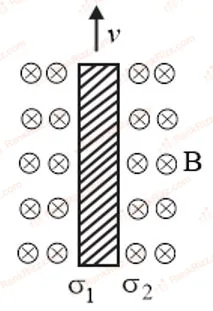
Consider a thin metallic sheet perpendicular to the plane of the paper moving with speed v in a uniform magnetic field B going into the plane of the paper (see the figure below). If the charge densities and are induced on the left and right surfaces respectively of the sheet, then (ignore fringe effects)
SOLUTION
When the metallic sheet moves with a velocity in a uniform magnetic field , the free electrons inside the conductor experience a Lorentz force () given by
Velocity is in the upward direction (). Magnetic field is into the plane of the paper ().
Using the right-hand rule for the cross product , (direction to the left). For a positive charge, the force is toward the left. For an electron (negative charge), the force is toward the right.
(In the steady-state equilibrium, the electric force () on the charges must exactly balance the magnetic Lorentz force)
(field between the surfaces for a thin sheet can be modeled as that of two parallel oppositely charged plates)
The left surface is positively charged: . The right surface is negatively charged:
Tagged Motional emf in moving rods and loops. Machine-assigned, so read it as a strong shortlist rather than a verdict.